
What is the correct tyre pressure and ground pressure when seeding and ploughing with agricultural tyres?
Excessively high tyre pressure increases soil pressure and raises the risk of soil compaction. Too low a pressure without proper calculation can lead to excessive carcass load. At the same time, tyre pressure and weight distribution directly influence the slip ratio and fuel consumption.
The technical setup of agricultural tyres is therefore not a minor detail, but a determining factor for soil structure, machine efficiency and crop yield potential.
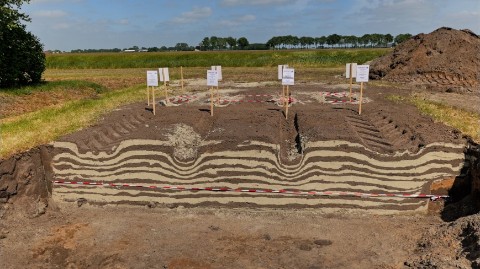

This article was written by Gerrit Jonker
Gerrit Jonker is an Agricultural Account Manager at Profile Heuver and has been active in the tyre industry since 1983. He is also a trainer at VakMans, Heuver’s training centre. With his many years of hands-on experience, he shares his knowledge with customers and new tyre specialists.
Soil pressure and contact patch: the technical foundation
Soil compaction occurs when pressure per square centimetre becomes too high. This pressure is determined by three variables:
• Load per tyre (kg)
• Tyre pressure (bar)
• Contact patch area (cm²)
Formula:
Load ÷ tyre pressure = theoretical contact patch area
When tyre pressure is higher than technically required, the contact patch becomes smaller. As a result, pressure concentrates in the tyre track and can penetrate into deeper soil layers.
Research within the agricultural sector shows that repeated soil compaction over multiple seasons can lead to significant yield loss, because root development and water management are restricted.
In spring this risk is greater due to higher soil moisture and lower soil bearing capacity.
Conclusion:
Soil pressure should be calculated based on actual load and tyre pressure, not on standard settings.
Correct tyre pressure adjustment: field work versus transport
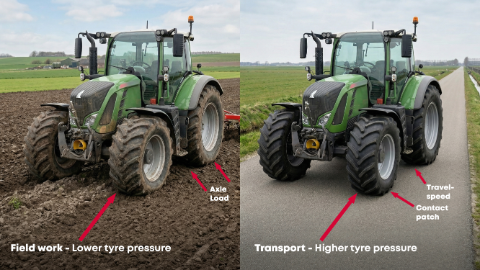
The correct tyre pressure follows the manufacturer’s load/speed tables and is determined by:
• Actual axle load
• Driving speed
During field work, speeds are generally lower than during transport. This allows lower tyre pressure, provided it remains within the permitted technical specifications.
Industry publications also emphasise the importance of dynamic adjustment: tyre pressure that is too low on the road leads to accelerated wear and heat build-up, while tyre pressure that is too high in the field increases ground pressure and causes rutting.
Both excessively low and excessively high tyre pressure increase fuel consumption.
Tyre pressure must therefore be adjusted according to the application: field or road.
Conclusion:
The optimal tyre pressure is a calculated and application-dependent value, not a single fixed pressure for all conditions.
IF and VF tyres: higher load capacity at lower pressure
To combine higher axle loads with lower ground pressure, IF and VF tyres are used.
An IF tyre (Improved Flexion) allows up to 20% lower tyre pressure at the same load.
A VF tyre (Very High Flexion) allows up to 40% lower tyre pressure at the same load.
Technical effect:
• Larger contact patch
• Lower pressure per cm²
• Improved traction
• Reduced slip
• Lower fuel consumption
The difference becomes clear when a standard radial tyre operates at 1.2 bar, while a VF tyre can function at 0.8 bar under the same load.
At 1.2 bar, the contact patch is smaller and the load is concentrated more strongly under the centre of the tread. The pressure penetrates deeper into the soil layers, increasing the risk of subsoil compaction.
At 0.8 bar, the tyre deforms more across the contact patch, distributing the load over a larger area. The pressure per cm² decreases and remains more limited to the topsoil layer. This reduces deep structural damage and limits rut formation.
Practical experience and industry insights show that a larger contact patch not only improves soil protection but also contributes to more efficient power transfer and lower fuel consumption per hectare.
Conclusion:
IF and VF technology increase the contact patch, reduce pressure per cm² and limit deep soil compaction under high loads.
Slip ratio during ploughing: monitoring efficiency
During ploughing, controlled slip is necessary for optimal traction.
Optimal slip range: 8–15%
• < 8% → traction potential is not fully utilised
• > 15% → energy loss, increased wear and higher soil load
Tyre pressure, weight distribution and tread design directly influence the slip ratio.
Industry publications emphasise that correct tyre pressure not only reduces slip but also improves diesel consumption per hectare because power is transferred more efficiently.
Conclusion:
The slip ratio serves as a practical indicator for the correct adjustment of tyre pressure and weight distribution.
Lead ratio on four-wheel drive tractors (4WD)
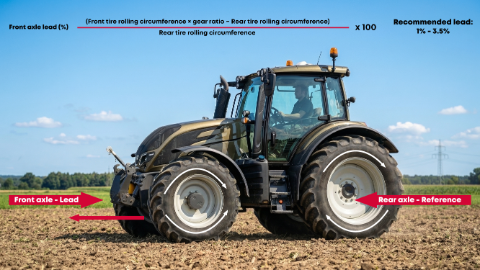
When changing tyre size or tyre type (for example switching to VF tyres), the rolling circumference ratio between the front and rear axle must be checked.
The recommended lead generally lies between +1% and +3.5%.
Formula:
((Rolling circumference front tyre × transmission ratio) − rolling circumference rear tyre)
÷ rolling circumference rear tyre × 100 = lead (%)
Incorrect gearing can lead to:
• Accelerated tyre wear
• Additional transmission load
• Reduced efficiency
The tyre configuration therefore affects not only the soil but also the mechanical load on the drivetrain.
Conclusion:
A correct lead ratio prevents mechanical overload and supports efficient power transfer.
Central tyre inflation systems: application-based optimisation
Machines that frequently switch between field work and transport benefit from central tyre inflation systems.
In the field:
• Lower tyre pressure
• Larger contact patch
• Lower ground pressure
On the road:
• Higher tyre pressure
• Lower rolling resistance
• Less heat build-up
Field measurements show fuel savings of approximately 7–10% when used correctly.
Conclusion:
Variable tyre pressure optimises both soil protection and transport efficiency.
Heuver advice: technical calculations as the standard
Seeding and ploughing require:
• Correct load calculation
• Tyre pressure adjustment per application
• Use of suitable tyre technology (radial, IF, VF)
• Monitoring of slip ratio
• Verification of rolling circumference and lead
• Correct tyre and wheel combination
Heuver Tyres combines specialist agricultural knowledge with technical product data and practical experience. By calculating systematically rather than estimating, not only is the soil protected, but the efficiency of both machine and field is optimised.
FAQ – frequently asked questions about agricultural tyres in spring
What is the ideal tyre pressure for ploughing?
That depends on the axle load and speed. Always use the manufacturer’s load/speed table.
Why is lower tyre pressure beneficial in the field?
Because the contact patch increases and pressure per cm² decreases, which reduces soil compaction.
When should I choose a VF tyre?
When axle loads are high and minimal ground pressure is required without losing load capacity.
What is the optimal slip ratio during ploughing?
Between 8% and 15% for efficient traction.
Why is lead important in 4WD?
Incorrect lead increases transmission load and accelerates wear.