
Solid or pneumatic tyres for earthmoving: which suits your application?
The choice between solid and pneumatic tyres therefore depends not only on the machine or the surface. Load, speed, driving distance and the length of the work cycles also play an important role.

This article was written by Anne Bouwmeester
Anne Bouwmeester is Business Unit Manager OTR & Industrial Tyres at Heuver and is responsible for OTR and industrial tyres. Together with the Heuver OTR team, he supports customers in sectors including mining and earthmoving with practical, technically substantiated tyre solutions. With this combined expertise, the team continuously works towards maximum uptime and reliable performance in the toughest conditions.
What is the difference between solid and pneumatic tyres?
A pneumatic tyre carries the load using air pressure. During operation, the carcass can deform. This allows the tyre to absorb part of the unevenness and shocks from the surface. The correct tyre pressure is important because it must match the load and application of the machine.
A solid tyre contains no air. This means the tyre cannot fail due to pressure loss after a puncture. This is an important advantage, particularly in locations where sharp materials regularly cause punctures or cuts.
This difference in construction also affects how the tyre performs in use. Solid and pneumatic tyres respond differently to load, speed, heat and uneven surfaces. The most suitable solution therefore becomes clear when you consider the machine’s entire work cycle.
When should you choose solid tyres?
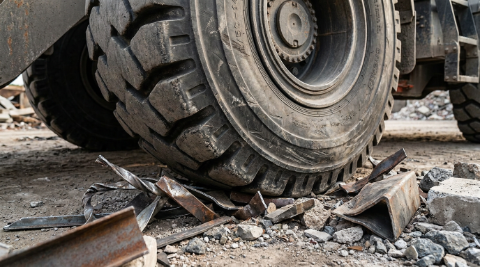
Solid tyres are particularly suitable when punctures are a recurring problem. This applies, for example, to machines working among scrap, waste, rubble or other sharp materials. A pneumatic tyre can lose pressure due to a puncture or deep cut, which may result in downtime. With a solid tyre, this specific risk does not exist.
That is why solid tyres are commonly used in recycling, waste, scrap and material-handling environments, where machines often make short movements and need to remain continuously available.
Because a solid tyre deforms very little, it absorbs shocks and unevenness less effectively than a pneumatic tyre. This can lead to more vibration for the operator and greater stress on machine components. This is particularly important to consider on rough surfaces or where machines cover many driving metres.
This does not mean that a solid tyre is automatically the best solution for every heavy-duty application. On larger earthmoving machines and during longer work cycles, heat build-up, speed, load capacity and driving behaviour also play an important role. A solid tyre can build up heat during intensive use. The selected version must therefore be suitable for the speed and duration of the application.
There are also differences between solid tyres in terms of tread pattern, construction and load capacity. The fact that a tyre cannot be punctured is therefore not enough on its own. The tyre must be technically suitable for the entire application.
When is a pneumatic tyre more suitable?
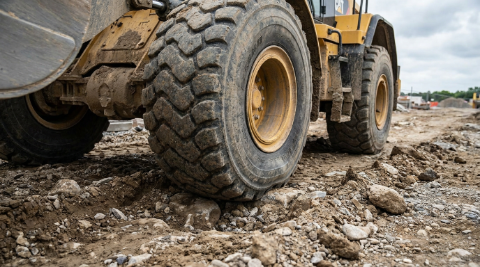
A pneumatic tyre is particularly suitable when a machine frequently travels over uneven, loose or varying terrain. Because the tyre and carcass can deform, part of the shocks from the surface are absorbed by the tyre.
This affects more than just driving comfort. Tyre deformation also influences contact with the ground. On sand, clay or unpaved surfaces, for example, this can provide benefits in terms of traction and stability.
The actual grip a tyre provides does not depend solely on whether it is pneumatic or solid. Tread pattern, construction, load and surface also play a role.
Tyre pressure requires continuous attention with pneumatic tyres. If the pressure is too low for the load, the carcass deforms more than intended. This generates more heat and places greater stress on the carcass. Correct tyre pressure is therefore an important part of good tyre management. You can read more about the relationship between load, speed and air pressure in the Heuver article about tyre pressure and solid tyres.
Which factors determine the choice between solid and pneumatic tyres?
The type of machine provides an initial indication, but it does not tell the whole story. Two similar machines may still require different tyres because of the way they are used day to day.
A machine that spends almost the entire day making short movements among sharp waste, for example, places very different demands on its tyres than a machine travelling longer distances across a rough worksite. In the first application, preventing punctures may be decisive. In the second, damping, heat build-up, traction and driving distance may be more important.
Therefore, consider the combination of:
- machine and tyre size;
- load;
- driving speed;
- surface;
- risk of punctures and cuts;
- length and intensity of work cycles;
- required traction and damping;
- heat build-up during prolonged use.
Costs should also be assessed in this broader context. In a location where pneumatic tyres are regularly damaged, repairs and downtime may ultimately outweigh the difference in purchase price. If punctures are rare, characteristics such as damping, energy consumption and suitability for longer work cycles may be more important.
The best choice is therefore not automatically the most robust or cheapest tyre, but the tyre that is technically best suited to the machine’s daily work.
When are solid tyres generally a good fit?
- High risk of punctures
- Scrap, waste or other sharp materials
- Short work cycles
- High machine availability is important
- Low to medium driving speeds
When is a pneumatic tyre generally more suitable?
- Loose or uneven terrain
- High traction requirements
- Longer driving distances
- More damping and driving comfort are desired
- Varying terrain conditions
This decision guide provides an initial indication. The final choice also depends on load, speed, tyre size, rim and the complete work cycle.
Can you simply replace a pneumatic tyre with a solid tyre?
No. A different tyre construction must also be technically compatible with both the machine and the rim.
With a pneumatic tyre, factors such as tyre size, load capacity, rim and correct tyre pressure must be considered. With a solid tyre, the tyre, rim, load capacity, speed and work cycle must also be compatible with one another.
The mounting process is also different. Solid tyres are pressed onto the rim using specialist equipment. Simply replacing an existing pneumatic tyre with a solid tyre without checking the complete wheel combination is therefore not the correct approach.
First, it must be confirmed that the tyre, rim and machine are technically compatible and that the selected tyre is suitable for daily use. Would you like to know more about the dimensions and technical components involved? Read more about how a rim is constructed and which dimensions determine the correct fit.
Heuver advice: start with the daily work cycle
Unsure whether to choose solid or pneumatic tyres? Do not start with the tyre type, but with the work the machine performs every day.
Do punctures or cuts occur regularly? How long does the machine operate continuously? At what speed? On what surface? And what load does the tyre need to carry? With this information, it usually becomes clear quite quickly which characteristics are most important.
The next step is the technical check. Tyre size, load capacity, speed, tread pattern and rim must all be compatible. For pneumatic tyres, this also includes the correct tyre pressure. For solid tyres, it must be checked whether the selected version is suitable for the speed and duration of the work cycle.
Heuver can assess tyre choice based on the machine, application, load, tyre and rim. Heuver can also press solid tyres for earthmoving machines. You can read more about this service on the page about pressing solid earthmoving tyres at Heuver.
FAQ – Frequently asked questions about solid tyres
Can a solid tyre be punctured?
A solid tyre contains no air and therefore cannot fail due to pressure loss after a puncture. The rubber itself can, however, wear, be cut or otherwise become damaged. Solid tyres should therefore also be inspected regularly.
Are solid tyres always better on rubble?
No. A high risk of punctures and cuts makes solid tyres an interesting option, but load, speed, driving distance and work cycle remain important. Especially during longer or faster work cycles, the tyre must be suitable for the heat generated during use.
Does a solid tyre cause more vibration than a pneumatic tyre?
Generally, yes. A solid tyre deforms much less and therefore absorbs less of the shocks and unevenness. This can result in more vibration for the operator and greater stress on machine components.
Does a pneumatic tyre provide more grip than a solid tyre?
Not automatically. The deformation of a pneumatic tyre can provide advantages on loose and uneven terrain, but grip also depends on tread pattern, construction, tyre pressure, load and surface.
Can I replace a pneumatic tyre with a solid tyre?
Not without a technical check. Tyre size, rim, load capacity, speed and application must be suitable for the solid tyre. The work cycle must also be appropriate for the selected version.
Which tyre is best suited to my earthmoving machine?
This cannot be determined based on machine type alone. Surface, load, speed, driving distance, work cycle and the risk of tyre damage together determine which construction and tread pattern are most suitable.