
Water-filled tyres for agricultural machines

Why use water-filled tyres?
Liquid ballast is used when agricultural machines require additional stability, traction and balance.
By adding water to the tyres, the centre of gravity is lowered, which improves performance on slopes, during heavy tillage or in situations where wheel spin must be prevented. The added weight also improves load distribution and reduces bouncing on uneven terrain.
Unlike loose materials such as soil or mud, liquid ballast is a fixed ballast: the weight remains constant during operation and does not shift with speed or load changes. This results in more predictable handling characteristics.
Water-filled tyres are particularly effective for:
- tractors with front loaders
- machines lifting heavy implements
- tractors requiring additional stability during transport
For machines that frequently switch between road transport and field work, a specialist can advise whether fixed or variable ballast is more suitable.
Conclusion: liquid ballast provides stable, predictable weight distribution and improved traction under demanding conditions.
How tyres are filled with water
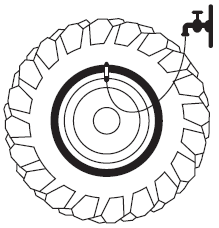
Tyres are filled with water using a special filling valve adapter. This adapter is mounted onto the valve after removing the valve core.
The wheel is positioned so that the valve is at the top, allowing air to escape while water is added. The filling adapter regulates both water inflow and air release, ensuring even filling.
During the process, approximately 25% of the tyre volume remains filled with air. This air volume is essential for maintaining inflation pressure and preserving the tyre casing structure.
Once the desired fill level is reached, the adapter is removed and the valve core is reinstalled. The tyre is then inflated to the correct pressure.
For tubeless tyres, proper rim protection is essential to prevent corrosion.
For more information about rims, see:
Different rim types explained
Conclusion: correct filling ensures a balance between added weight and tyre performance.
Calcium chloride (CaCl₂) as antifreeze solution
At sub-zero temperatures, water inside the tyre can freeze, causing damage or instability. To prevent this, calcium chloride (CaCl₂) is often added to the water.
This solution lowers the freezing point depending on its concentration and prevents ice formation inside the tyre. CaCl₂ is widely used because of its high density, cost-effectiveness and reliability in demanding conditions.
However, calcium chloride is corrosive when it comes into contact with untreated steel. Therefore, only rims with proper corrosion protection, such as powder-coated rims, should be used.
When mixing the solution, a key safety rule applies:
always add CaCl₂ slowly to water — never the other way around — as heat is generated during mixing.
Conclusion: CaCl₂ prevents freezing but requires proper handling and corrosion protection.
Example calculation of liquid ballast
A practical example: a tyre size 600/65R38 has a volume where approximately 75% equals around 500 litres of water.
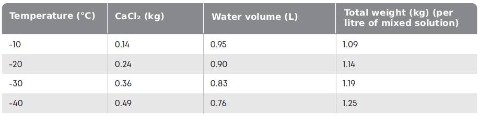
For protection down to -20°C, a solution of approximately 24% CaCl₂ is required.
Calculation:
- 500 litres × 0.24 = 120 kg CaCl₂
- water volume: 500 × 0.90 = 450 litres
- total added weight: 500 × 1.14 = 570 kg
This additional weight significantly improves machine stability, especially when using front loaders or performing heavy lifting operations.
When mixing, always add CaCl₂ gradually to the water while stirring. Never pour water onto dry CaCl₂ due to the strong heat reaction.
Conclusion: correct calculation ensures the right balance between weight and freeze protection.
Safety, application and advice
Safety is essential when working with liquid ballast. Calcium chloride should not be used as antifreeze in engine cooling systems and must be handled carefully.
In case of leakage, the solution should not come into contact with unprotected metal parts or agricultural soil.
Water-filled tyres are ideal for heavy field operations, but less suitable for machines frequently used on roads due to the additional weight.
During maintenance or mounting, always consider the increased tyre weight. Heuver specialists can advise whether liquid ballast is the right solution based on machine weight, implements, soil conditions and required traction.
For more technical information:
Conclusion: liquid ballast is effective for field work, but requires careful use and correct application.
FAQ
When should you use water-filled tyres?
For additional ballast, stability, traction and balance in agricultural machines.
What percentage of the tyre is filled with water?
Approximately 75% water and 25% air.
Why use calcium chloride?
As antifreeze and to increase weight, as it lowers the freezing point.
Are water-filled tyres suitable for tubeless tyres?
Yes, provided the rim is properly protected against corrosion.
Are water-filled tyres suitable for road transport?
Less suitable due to the additional weight.