
What is the difference between steer tyres, drive tyres and trailer tyres?
In practice, this often goes wrong. Tyres may look similar, but they function completely differently. The wrong tyre on the wrong axle often leads to less grip, irregular wear and higher costs.
In this article, you will learn the differences between steer tyres, drive axle tyres and trailer tyres, how to recognise them and why these differences exist.


This article was written by Maurits Bloem
Maurits is Business Unit Manager Truck Tyres at Heuver Banden and has been active in the tyre industry for many years. With his experience in sales and team management, he is responsible for the commercial results and managing the truck tyre department. His focus is on growth and building strong, long-term customer relationships.
Why does each axle have a different truck tyre profile?
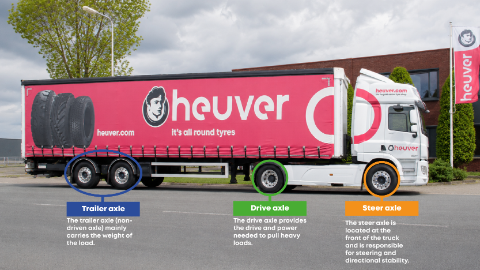
A truck distributes forces across several axles, and each axle has its own function. There are three main positions:
-
Steer axle, or front axle: responsible for steering and directional stability
-
Drive axle: converts engine power into traction
-
Trailer axle: carries the load and follows the vehicle
On the steer axle, everything revolves around maintaining and correcting direction. The drive axle has to convert engine power into movement, while under the trailer the focus is on carrying weight and absorbing lateral forces.
Because these functions are so different, the tread, shoulder and side-walls of truck tyres are also designed differently. A tyre that has to steer requires stability and continuous contact with the road, while a tyre that has to drive needs space to build up grip. Under a trailer, the focus is once again on wear resistance and stability under load.
Conclusion: the profile of a truck tyre is always matched to the function of the axle and cannot be used universally.
How do you recognise the difference between steer, drive and trailer tyres?
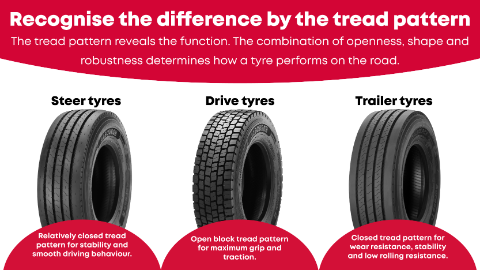
In practice, you can often recognise the type of tyre quickly. The tread pattern reveals its function, but it is mainly the combination of openness, shape and robustness that makes the difference.
-
Steer tyres have a calm and relatively closed appearance
-
Drive axle tyres have a more open tread pattern with clear blocks
-
Trailer tyres are robustly constructed, have a relatively closed tread pattern and are optimised for wear resistance and low rolling resistance.
The more grip a tyre needs to provide, the more open the tread pattern becomes. As wear resistance and stability become more important, you see a more closed and stronger design.
Conclusion: the structure of the tread pattern immediately shows what a truck tyre is intended for.
Steer tyres: focused on control and stability
On the steer axle, everything revolves around control. The tyre must respond precisely to steering movements and remain stable, even at higher speeds and on wet roads. That is why the tread pattern is designed to keep contact with the road as constant as possible. This prevents instability in the steering and ensures predictable driving behaviour.
When tyre pressure and alignment are correct, this is also reflected in the wear pattern. The tyre wears evenly and retains its performance over a longer period. In practice, you notice this immediately: the truck stays calmly on course and responds exactly as expected.
Conclusion: steer tyres are designed for maximum control, stability and predictable wear.
Drive tyres: built for traction
The drive axle converts engine power into movement. This requires grip, especially when pulling away, under heavy loads and in challenging conditions. The tread pattern of drive tyres is therefore more open and made up of blocks that can bite into the road surface. This allows the tyre to build up traction, even when conditions are less favourable.
This open structure also means that the tread pattern moves more while driving. That is necessary to create grip, but at the same time it makes the tyre more sensitive to wear if it is not used on the correct axle. In practice, you can see that a truck with the right drive tyres pulls away in a controlled way and is less likely to slip, even under load.
Conclusion: drive tyres are specifically developed to convert power into traction, even under heavy conditions.
Trailer tyres: focus on load capacity and service life
Trailer tyres have a different role from steer and drive tyres. They do not steer and are not driven, but they continuously carry heavy loads. In addition, when cornering and manoeuvring, they are exposed to lateral forces that have a major impact on wear.
That is why the focus with these tyres is on stability and durability. The tread pattern is robust and relatively closed, with extra attention paid to the shoulders of the tyre. This is exactly where wear occurs when tyre pressure or alignment is not optimal. At the same time, the rolling resistance of truck tyres also plays an important role. Because trailer tyres continuously rotate without being driven,
In practice, you can see that well-chosen trailer tyres last a long time and remain stable, even with intensive use.
Conclusion: trailer tyres are designed to withstand heavy loads and lateral forces over a long period.
What happens if you fit the wrong truck tyre?
Using the wrong tyre on an axle position has immediate practical consequences. Because each tyre is designed for a specific function, deviations occur as soon as you move away from that function. A tyre intended for steering performs differently when it has to provide traction, and vice versa.
You may notice this, for example, because the truck steers less stably, slips more quickly when pulling away or wears irregularly. That wear often develops gradually, but ultimately results in a shorter service life and higher costs per kilometre. Fuel consumption and driving comfort can also be negatively affected.
Conclusion: choosing the wrong tyre for an axle position directly leads to poorer performance, more wear and higher operating costs.
Heuver advice
Choosing the right tyres starts with the correct axle position. From there, you look at how the vehicle is used and the conditions in which it operates.
Pay attention to:
-
the truck tyre application, such as long-distance, regional, urban or construction transport
-
the load and driving conditions
-
the desired balance between grip, service life and fuel consumption
By taking these factors into account, you prevent unnecessary wear and get the maximum return from your truck tyres.
FAQ
What is the difference between steer tyres and drive tyres?
Steer tyres provide stability and control, while drive tyres are responsible for traction and transferring power to the road.
How do you recognise a drive tyre?
By its open tread pattern with clear blocks and spaces that provide extra grip.
Can you use a steer tyre on the drive axle?
No, this leads to insufficient traction and increased wear.
Why do trailer tyres often wear on the sides?
Because of lateral forces during cornering and manoeuvring, especially when tyre pressure or alignment is not optimal.
What does axle position mean for truck tyres?
The axle position indicates on which axle the tyre is mounted, such as the steer axle, drive axle or trailer axle.