
Tyres in mining: how to choose the right OTR tyre for every application


This article was written by Anne Bouwmeester
Anne Bouwmeester is Business Unit Manager OTR & Industrial Tyres at Heuver and is responsible for the OTR and industrial tyre activities. Together with the Heuver OTR team, he supports customers in sectors such as mining and earthmoving with practical and technically sound tyre solutions. Based on this combined expertise, the focus is always on maximising uptime and ensuring reliable performance in the toughest conditions.
Why mining tyres are a separate category
Mining tyres belong to the most demanding category within OTR. Rigid dump trucks, articulated dump trucks, wheel loaders and underground mining equipment require tyres that can not only carry high loads, but also withstand heat, cuts, impact damage and wear. Manufacturers explicitly define the combination of heat resistance, cut resistance and wear resistance as the core of tyre selection in earthmoving applications.
Tyre selection in mining is therefore always a compromise: more rubber and more protection often increase tyre life, but can also lead to additional heat build-up. This balance determines whether a tyre performs efficiently on a specific site.
Conclusion: mining tyres should never be selected based on tread alone, but on the balance between heat resistance, wear resistance and cut and impact resistance, combined with site productivity.
Surface mining and underground mining require a different approach
In surface mining, the focus is primarily on haulage performance, heat management and tyre life. Key factors include load, speed, distance and TKPH (Ton Kilometres Per Hour). The tyre rating must match the site requirements; if the tyre capacity is too low, the risk of overheating and premature tyre failure increases significantly. Goodyear identifies this as a fundamental step in selecting haul truck tyres.
In underground mining, the focus shifts towards robustness, traction, stability and protection against sharp obstacles. Aeolus positions underground mining tyres specifically around cut resistance, stability and traction.
Conclusion: surface mining is primarily about heat control and productivity per cycle, while underground mining focuses on protection against damage and high mechanical stress.
What do E- and L-codes mean?
The international OTR classification system uses letters to indicate application and numbers to indicate tread type.
- E = earthmoving / transport
- L = loader / dozer
- E3 / L3 = standard tread (100%)
- E4 / L4 = deep tread (150%)
- L5 = extra deep tread (250%)
Conclusion: use E- and L-codes as a technical foundation, but always determine the final tyre choice based on application, site conditions and compound.
Terrain determines tread selection
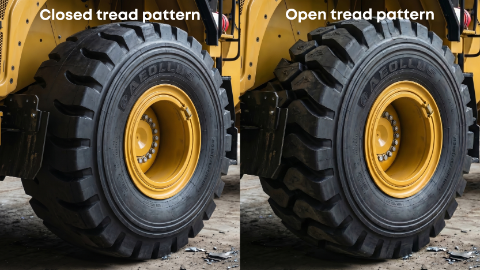
In practice, the terrain determines whether traction or protection is the priority. In mining, a distinction is often made between an open tread pattern and a closed tread pattern.
An open tread pattern (self-cleaning) is used on soft or muddy surfaces, where traction and material release are essential.
A closed, more compact tread pattern is preferred on hard, rocky or aggressive terrain, as it offers better protection against cuts, chipping and penetration from sharp rocks. Aeolus clearly illustrates this with AL519 self-cleaning treads for muddy sites and AL53/AL518 closed, compact treads for rocky conditions.
This is particularly relevant in areas with sharp debris, such as loading zones or around crushers. In these zones, a more open tread is more vulnerable to stone penetration and damage.
Conclusion: the more aggressive and harsh the environment, the more important a closed tread pattern and additional protection become.
Compound is often the decisive factor in mining
At least as important as the tread pattern is the compound, which plays a key role when selecting the right OTR tyre for different applications. It determines how the tyre responds to heat, wear and cuts.
In large surface mining operations, TKPH plays a crucial role. The compound must match the load and average speed of the site. If the tyre is not thermally suitable, this leads to overheating and accelerated failure.
In aggressive conditions, the focus shifts towards tyres with high cut resistance or additional protection against damage. Bridgestone highlights specific compounds and reinforced sidewall constructions for severe rock conditions to improve resistance to cuts and chipping.
In practice, compounds are often a combination of properties tailored to the specific application.
Conclusion: in mining, you do not only select a tread pattern, but primarily a compound that matches heat load or maximum resistance to damage.
Do not overlook the sidewall
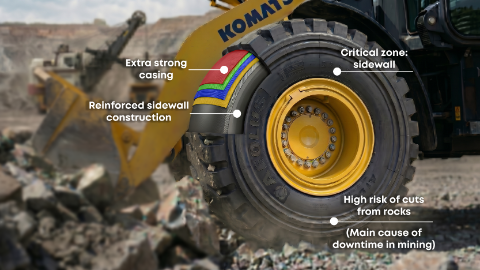
The sidewall is a critical area in heavy mining applications. Sharp rocks and debris can quickly cause damage, leading to downtime or failure.
That is why manufacturers place strong emphasis on reinforced sidewall constructions, durable casings and designs that reduce the risk of sidewall damage. Aeolus, Bridgestone and Goodyear all explicitly highlight this in their mining tyre ranges.
Conclusion: focusing only on tread depth and ignoring sidewall protection means overlooking one of the main causes of tyre failure in mining.
Radial is the standard in modern mining
For modern mining applications, radial tyres are the standard. They offer better heat dissipation, higher productivity and lower cost per hour. Michelin clearly positions its Earthmover range as radial, highlighting the benefits for performance and durability.
Bias tyres are still available, but are mainly used in niche applications such as low speeds, short cycles or extremely cut-aggressive conditions where heat build-up is less critical.
Conclusion: radial tyres are the standard, while bias tyres are a deliberate choice for specific applications.
Tyre management is crucial
Even the best tyre will fail without proper management. Key factors include:
- correct tyre pressure
- consistent loading
- maintenance of haul roads
- monitoring of tyre temperatures
Conclusion: mining tyre performance is determined as much by management as by product selection.
Heuver advice: how to choose the right mining tyre
Selecting the right mining tyre starts with five key questions:
- is the application surface mining or underground?
- how aggressive is the terrain (wear, impact or cuts)?
- is traction more important, or protection?
- what TKPH value applies to the site?
- is additional sidewall protection required?
At Heuver, we therefore look beyond size and tread pattern, focusing on cost per operating hour, risk of failure and suitability for real site conditions.
Conclusion: the best tyre choice in mining is achieved by evaluating tread, compound, site load and sidewall protection together.
FAQ
What do L3, L4 and L5 mean?
L3 indicates a standard tread (100%), L4 a deep tread (150%) and L5 an extra deep tread (250%).
What is more important in surface mining: traction or protection?
This depends on the site. On muddy terrain, an open tread improves traction; on rocky or sharp surfaces, a closed tread is usually safer.
Why is TKPH so important?
TKPH indicates whether a tyre is thermally suitable for the load and speed of the site. If not, the tyre can overheat and fail prematurely.
Why is reinforced sidewall construction so important?
Because cuts and impacts in the sidewall are a common cause of failure in harsh mining environments. Manufacturers therefore integrate reinforced sidewalls and protective features.